
Learning of the Advanced Tackling System - Part Three
With the 2018 High School Football Season just a few weeks away in New York, I was excited and charged with energy thanks, in part, to my time at the Advanced Tackling Pilot Clinic in Philadelphia. I knew that we were in the midst of transition and change within the program and I knew that we were going to be young and inexperienced. We’d recently graduated some very good athletes among the 14 seniors that were departing from our 21 player team in 2017. We are classified as a small school and we have a relatively small team so losing two thirds of our players (not starters, players) would prove challenging. Our numbers at the Varsity level heading into 2018 were similar. We had slightly better numbers on our Junior Varsity team and had already made the decision to continue practicing together every day, a decision that benefited our youngest players significantly.
As I stated in a previous article, we are a Class B Football School in Section VI which roughly encompasses the Westernmost part of the state of New York from Lake Ontario to the Pennsylvania border, running parallel with Lake Erie. Class B is the middle classification for public schools in the state. B Schools have between 355 and 584 students enrolled, our enrollment is 394. Numbers in the area have trended to a point where 21-25 player Varsity rosters are common. My staff is comprised of a total of 7 coaches, program wide. Varsity football is afforded one head coach and two assistants, the Junior Varsity is staffed with one head coach and one assistant, and our Modified team has the same set up. Since JV and Varsity practice together, I have myself and four other coaches to work with. This is a luxury compared to the years before we started practicing together on a full time basis. Within my network of coaches through USA Football, we are a small staff. An extremely small staff. This staff size in our area is not uncommon though.
RELATED CONTENT: Learning of the Advanced Tackling System - Part Two
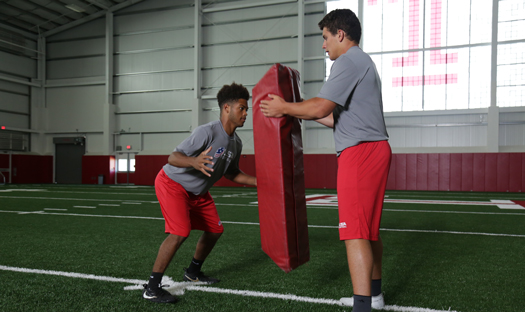
Heading into the season, I felt that the goal of becoming a good tackling football program was sound. I knew that I had access to a network of coaches and a system that not everyone had access to and I wanted to utilize that information and those people to help my players as much as possible. During the pilot clinic in Philadelphia, I was introduced to the GSI tackle bags and pads. These bags were different. They were heavy. It seemed so obvious after watching players tackle the GSI bags. We don’t ask our quarterbacks to throw footballs that are significantly lighter than the ones they throw on Friday night. We don’t ask our offensive linemen to work exclusively against defensive backs during an inside run period or team. Why are we tackling things that are significantly lighter than what we need to tackle on Friday night? The counter argument is that we should work on tackling by tackling other players. On a team of 21, I’m not willing to risk our overall health and safety by generating that many more opportunities for full contact. Not to mention the fact that full contact tackle circuits significantly alter the amount of time that we have to go full contact during practice, we would have to steal that time from a team period or a goal line period. The bags made sense and I didn’t have the funds immediately available to obtain them. This is when our creativity and willingness to try and fail as a staff became paramount.
For a couple of seasons I’d been watching videos sent to me from Vince DiGaetano that utilized half rounds, tackling bags, shields, pool noodles, and even pvc pipe for a number of drills. Some of the concoctions that Coach would come up with got me thinking of the number of times he likely ran to the hardware store and what the people that helped him find what he was looking for must have thought. It wasn’t until we started trying to create more accurate replications of what we were asking our players to do in games that all of this extra effort made sense. My work over the summer had introduced me to another innovator, Coach Rob Everett. Rob’s videos were similar to Vince’s videos when it came to creativity. I again need to cite the benefits of being a part of the coaching network that I am a part of. Our text thread and Twitter thread is essentially a constant stream of consciousness centered on best practices. Much of our work has hinged on tackling but this isn’t always the case. Program management comes up often and interestingly, scheme has taken a back seat. Early on, coaches were sharing video of a tackling bag attached to a thick elastic resistance band, an idea that Richie shared with Andy some months prior. Players would initiate the tackle and they would be required to focus on clamp and grip in order to finish the tackle successfully and in a dominant manner. How simple? Why didn’t I think of that? Simply try to pull the bag away and make them focus on clamp and grip. The previous year, I was so excited about the three tackle wheels that we purchased because I thought we’d be ahead of the curve. While the wheels are excellent for tracking and even for block destruction leading to a tackle, players, especially older players, don’t meet any resistance when tackling them. The GSI bag, depending on the level, can provide 70 pounds of resistance and a center of gravity that causes any coach to second guess their desire to demonstrate. Not having those particular bags in the program, we found that the resistance band tackles not only forced our players to have to work hard to keep their cleats in the ground, and dominate their clamps and grips, it also had a few of our coaches breaking a sweat as the pulled the bands.
RELATED CONTENT: Learning of the Advanced Tackling System - Part One
GSI bags are also equipped with grips so that tacklers aren’t able to move them with flat hands. “Clamp or Cloth” became a part of our nomenclature over the course of the season. Even with the band, many of our players were striking the bag with flat hands simply because there was nothing to grab ahold of to secure and dominate the tackle. The simple task of sliding an unused practice jersey over the bag remedied this. Our bags and our tackle circuits were starting to look like something that Coach DiGaetano had shared. These ideas weren’t new. They were just new to us. We began taking photos and filming specific elements of the circuit. To passers by, our tackle circuit must have looked like a circus complete with props, crashpads, and acrobatics. We were able to get creative because of the collective understanding that was starting to build with regard to the tackle. These are just a few of the ideas that were generated over the course of the season to help us provide realistic conditions for our players when it came to tackling.
We finished the season well below expectations from the perspective of wins and losses. However, years like the one we just experienced force coaches to reflect on well, everything. Seasons like this may even force us to redefine success. We managed to find a sense of success in our extremely hard working Senior outside linebacker that notched 125 tackles, a single season program record, and moved to number 1 all-time in career tackles this year thanks, in part, to a remarkable 20 tackle final game performance. The fact that his most productive tackling game, which pushed him over the top for both records was the final game of the season speaks to the quality of the Advanced Tackle System as a whole. When coaches and players buy in, culture changes. Our tackling culture has shifted. We didn’t do everything right. We didn’t even do everything. We’ve got a lot of work ahead as a staff as we assess our returners throughout the off season and work to devise a way to share the workload and assess tackling more consistently throughout the season so that our tackle circuit drills can be more prescriptive. Advanced Tackling rolls out, officially, this February at USA Football’s National Conference in Orlando. I’m looking forward to continuing my journey and the journey of our football program. I’m looking forward to sharing more about our story in Orlando and I’m eager to learn more so that we can create a comprehensive plan for next season.
RELATED CONTENT: USA Football Tackling Systems
ADVANCED TACKLING SYSTEM - AVAILABLE NOW
Your defense is only as good as each tackler. Equip your staff with a common language, a systematic teaching progression and evaluation tools to coach better tacklers.